
What Supplies Do You Need for Sunday School?

Last Updated: October 25, 2026
Quick Summary
Sunday school supplies fall into three groups: room basics like child-safe scissors, crayons, glue sticks, and wipes; lesson-specific items like flannel board Bible stories, puppets, peek boards, and black light kits; and consumables like paper plates, cotton balls, and stickers that you buy in bulk.
Room basics last months, lesson-specific items last years if stored well, and consumables vanish fastest.
Match materials to the stage: babies need soft sensory props, toddlers need participation like peek boards.
Anything small enough to fit through a toilet-paper tube is a choking risk for babies and toddlers.
Label storage bins by story, not just by item, so a substitute volunteer can find what they need.
Restock weekly by noting low consumables, order monthly in bulk, and do a full inventory seasonally.
Table of Contents
Start with a Sunday School Supplies Checklist
Three categories every classroom needs
Children's Ministry Supplies That Work for Volunteers
Preschool Bible Lesson Materials for Babies and Toddlers
Match the material to the stage
Adapt for different abilities
Safety, allergies, and cleanliness
Black Light Bible Story Kits: A Multi-Sensory Option
Flannel Board Bible Stories for Little Hands
How to Budget and Store Your Sunday School Supplies
Build a supply system, not a supply pile
Reusable kits versus consumables
A replenishment rhythm that fits church life
Cleanliness and safety in storage
Plan Your First Supply Order with Palma Smiley
Frequently Asked Questions
Start with a Sunday School Supplies Checklist
A workable Sunday school teaching supplies list breaks into three groups: room basics, lesson-specific items tied to your curriculum, and consumables you restock all year. Get those sorted and you can walk into any nursery or toddler room knowing nothing essential is missing.
The short version:
Room basics: child-safe scissors, crayons, colored pencils, pre-sharpened pencils, glue sticks, washable markers, tissues, wipes, and a spill-proof cup caddy.
Lesson-specific items: flannel board Bible stories, puppets, peek boards, story bags, and black light Bible story kits for the lessons that call for them.
Consumables: paper plates, cotton balls, pom-poms, pipe cleaners, googly eyes, stickers, stamps, and index cards for flashcards.
Below, we break down each category, how to match supplies to age groups, and how to budget and store everything so volunteers find it. You can also browse the full catalog of downloadable lesson CDs and song resources to see what's available.
Three categories every classroom needs
Think of your checklist as three tiers restocked at different rhythms. Room basics last months, lesson-specific items last years if stored well, and consumables vanish fastest, buy them in bulk and keep a backup bin.

Here is the short version of the checklist, grouped by how often each category needs restocking.
Category | What's included | Restock rhythm |
Room basics | Child-safe scissors, crayons, colored pencils, glue sticks, washable markers, tissues, wipes, cup caddy | Last months |
Lesson-specific items | Flannel board Bible stories, puppets, peek boards, story bags, black light Bible story kits | Last years if stored well |
Consumables | Paper plates, cotton balls, pom-poms, pipe cleaners, googly eyes, stickers, stamps, index cards | Vanish fastest; buy in bulk |
Children's Ministry Supplies That Work for Volunteers
The best children's ministry supplies are the ones a first-time volunteer can pick up and use without training.
Generic craft supplies fall short here. Crayons and paper keep hands busy but do not carry a Bible lesson.
A common mistake is buying supplies for the teacher's comfort instead of the child's attention span. For practical, age-appropriate methods, see this step-by-step guide to teaching Bible to toddlers.
Preschool Bible Lesson Materials for Babies and Toddlers
Preschool Bible lesson materials should match the developmental stage, not the calendar. A room of 12-month-olds and a room of three-year-olds need different things even when learning the same story. Getting this wrong is the most common reason a lesson falls flat, the prop is too small, the story too long, or the activity assumes motor skills the children do not have yet.
Match the material to the stage
Babies (birth to about 18 months). The goal is sensory exposure: soft props, gentle songs with repeated motions, and short visual moments.
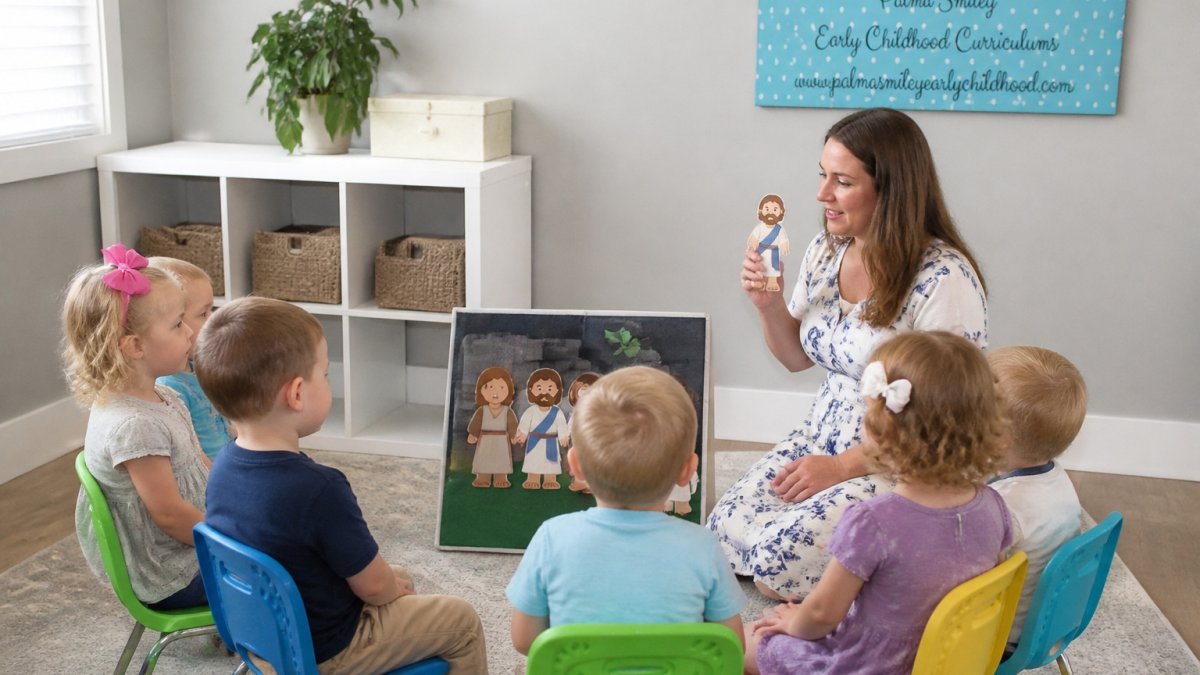
Toddlers (about 18 months to three years). Add participation. Peek boards they can open, puppets that "talk" to them, and simple flannel board figures they can help place turn listening into doing. The rule of thumb: one prop per key story moment, and never more than a child can hold at once.
Mixed-age rooms. Many churches run a combined nursery-and-toddler class, and the material has to work for both at once.
Adapt for different abilities
A nursery or toddler room often includes children with different needs. A few simple adaptations make the same lesson work for everyone:
Visual and hearing differences: pair every song with motions and every story with a prop, so children can follow through more than one sense.
Sensory sensitivity: keep a quiet corner with soft items for a child who finds the group overwhelming, and introduce new textures, cotton balls, felt, glow stars, one at a time rather than all at once.
Motor differences: choose props that are easy to grasp and place, and let a child participate by pointing or holding rather than only by placing figures.
Safety, allergies, and cleanliness
Because these materials go into the hands and mouths of very young children, safety is part of the lesson plan.
Choking hazards: anything small enough to fit through a toilet-paper tube is a choking risk for a baby or toddler. Keep googly eyes, tiny flannel pieces, and craft beads out of the child-accessible bins.
Non-toxic materials: choose washable, non-toxic markers, crayons, and glue, and check labels on anything a child might mouth.
Allergies: ask parents about allergies before the teaching year starts and note them on the room roster. Common culprits in craft supplies include certain adhesives, scented markers, and latex in some elastic or balloon items.
Watch Out Test any new prop or material with your own class before building a lesson around it. A texture a toddler loves one week can be the thing that unsettles the room the next.
If you are planning for the youngest class, our materials are built for ages birth to 18 months, so you are not stretching a toddler lesson down to fit.
Black Light Bible Story Kits: A Multi-Sensory Option
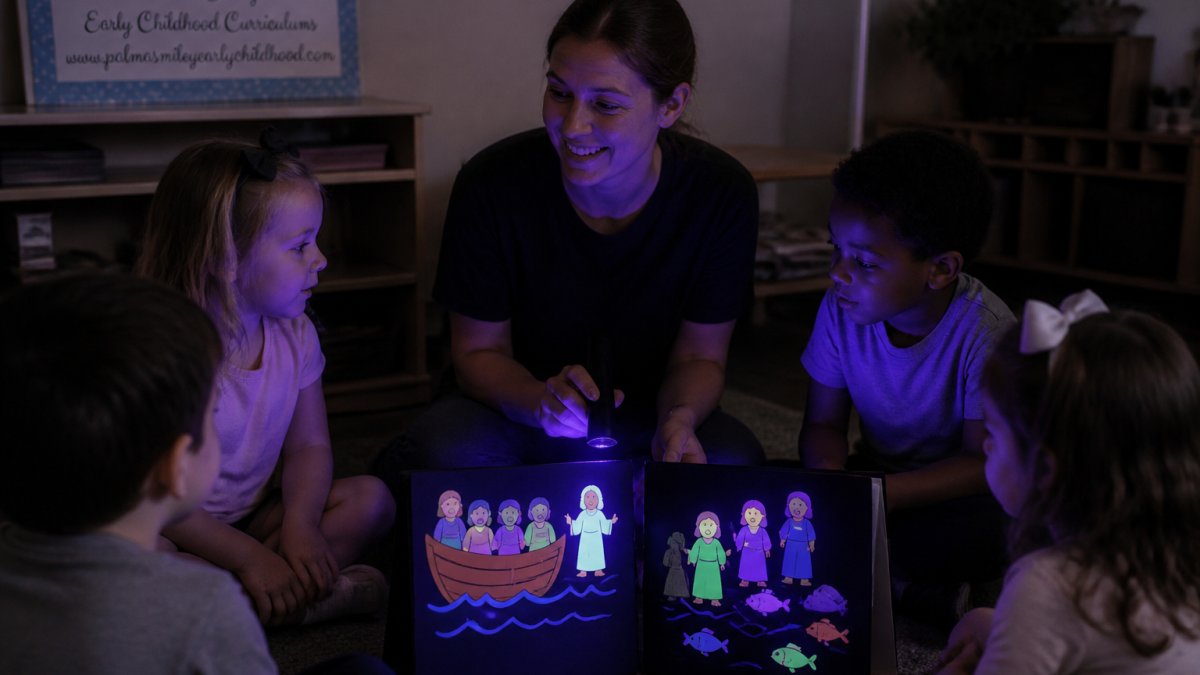
A black light Bible story kit uses fluorescent figures and props under a black light so the story glows in a darkened room, the closest thing to a "wow" moment you can give a preschooler in a Sunday school classroom.
The effect works because it changes the room. To try the multi-sensory approach, you can purchase a specific kit like the Jonah and the Great Fish Black light Story Kit.
Watch out: black lights need a room you can actually darken, and some little ones find the sudden dark unsettling.
Flannel Board Bible Stories for Little Hands
Flannel board Bible stories are the workhorse of the toddler classroom. Figures stick to a felt board as the story unfolds, and children can help place them, which turns listening into doing.
What most guides miss is how much the flannel board supports routine. The board comes out, the same opening song plays, the figures appear in the same order.
How to Budget and Store Your Sunday School Supplies
Most supply guides stop at the shopping list. The harder question is what happens Sunday morning when a volunteer cannot find the flannel board figures for the Creation story, or the glue sticks run out mid-lesson and nobody knows who restocks them. Storage and replenishment are where a supply plan holds up or falls apart.
Build a supply system, not a supply pile
The goal is a system a substitute volunteer can walk into cold: everything visible, everything labeled, and everything tied to a story or unit rather than dumped by category.
A workable pattern many churches land on:
Clear bins, not deep shelves. Clear bins let a volunteer see what is inside without pulling everything out. Deep shelves hide supplies and encourage the "buy it again because we can't find it" cycle.
Label by story, not just by item. A bin marked "Noah" with the animal figures, a short script card, and the song motions beats a bin marked "felt figures" every time.
One-page inventory inside the closet door. A simple sheet listing what belongs in each bin lets volunteers note what they used and what is running low. No app required.
Reusable kits versus consumables
Your closet supplies fall into two rhythms, and mixing them up wrecks a budget.
Reusable items, flannel boards, puppets, peek boards, story bags, black light kits, are a one-time investment that spreads across years if stored well. Keep them on a shelf protected from dust and heat, with bulbs and small pieces in their own containers.
Consumables, paper plates, cotton balls, pom-poms, pipe cleaners, googly eyes, stickers, stamps, index cards, vanish fastest and should be bought in bulk with a backup bin kept separate from the active supply. For a budget-friendly first order, consider the all-in-one Kindness/Good Samaritan Curriculum Box for Toddlers, which bundles scripts, a story kit, and puppets.
Pro Tip Label the backup bin "NEXT" and the active bin "NOW." It sounds small, but it removes the guesswork for a volunteer who has never restocked before.
A replenishment rhythm that fits church life
Most churches find a simple rhythm works better than a complicated system:
Weekly: volunteers note low consumables on the inventory sheet during cleanup.
Monthly: the supply coordinator checks the restock bin and the backup bin, and places one bulk order for consumables.
Seasonally: before VBS, Christmas, Easter, and the start of a new teaching year, do a full inventory pass and check reusable kits for missing pieces.
That seasonal pass matters more than it sounds. Flannel board figures go missing, puppet eyes loosen, and black light bulbs get bumped. Catching those before a big teaching season saves a scramble the week of the event.
Cleanliness and safety in storage
Because these supplies go into the hands and mouths of babies and toddlers, storage and cleanliness are a safety issue.
Plan Your First Supply Order with Palma Smiley
The hardest part of a first supply order is knowing what to buy together so a lesson actually works. Start with room basics, add one reusable story set per age group, then fill in consumables last.
At Palma Smiley Early Childhood, we build materials for exactly this: Bible-based curriculum for babies, toddlers, and preschoolers, with black light story kits, puppets, peek boards, and story bags that make early religious education visual and hands-on.
Get started with Palma Smiley Early Childhood and give your youngest class supplies that carry the lesson, not just fill the hour.
Frequently Asked Questions
What supplies do you need for a Sunday school classroom?
Start with three groups of Sunday school supplies: classroom basics like crayons, child-safe scissors, glue sticks, and washable markers; teaching aids such as puppets, flannel boards, and story kits; and Bible study materials including picture Bibles, flashcards, and parent handouts. For babies and toddlers, add sensory props like cotton-ball clouds, glow stars, and animal toys. Keep a small inventory list taped inside a cabinet so volunteers know what to restock each week.
What is the difference between black light story kits and flannel boards?
Black light Bible story kits use a UV light to make glow-in-the-dark figures and scenes appear, which grabs the attention of babies and toddlers during story time. Flannel board Bible stories use felt figures pressed onto a board, so children can touch and move the pieces themselves. Both are preschool Bible lesson materials, but black light kits work well for large-group storytelling, while flannel boards suit small-group, hands-on participation.
How do you keep Sunday school supplies clean and safe for toddlers?
Choose washable, non-toxic materials and check labels for small parts that could be a choking hazard. Wipe down hard toys and boards with a child-safe cleaner after each session, and wash fabric props according to their care tags. Store supplies in labeled bins out of reach between classes. If a child has allergies, note it on your parent communication sheet and keep shared items like playdough or scented markers separate.
How can volunteers with no teaching background prepare a simple lesson?
A simple lesson plan works for any volunteer: pick one Bible story, choose one song with repeated motions, and set out two or three sensory props that connect to the story. Practice the story once at home with the flannel board or black light kit so you know the sequence. Keep a routine of welcome, song, story, and prayer so children know what comes next. Palma Smiley Early Childhood materials are designed for volunteers, not trained teachers.
Building a Sunday school supply closet that works for volunteers, not just for storage, takes a little planning up front and a simple restock routine after that. Palma Smiley Early Childhood can help you get there with curriculum built for babies through preschoolers, multi-sensory teaching aids, and resources that suit both church and mission settings. Subscribe to our newsletter for planning tips and new lesson releases.
Subscribe to our newsletter
Add palmasmileyearlychildhood.com as a preferred source on Google →

Comments