
7 Christian Education Resources for Preschoolers That Work

Last Updated: October 26, 2026
Quick Summary
Christian education resources for preschoolers work best when they engage a child's whole body through touch, sound, sight, and routine rather than worksheets. A complete lesson includes four repeating parts: a story, a song, a prop, and a repeated phrase. Choose resources your volunteers can prepare in under 30 minutes and that match your room, age group, and setting.
Bible learning in early childhood builds warm, repeated associations between Bible stories and things children can feel, hear, and do.
Match resources to your volunteers: a first-time helper should prepare a lesson in under 30 minutes.
Filter any curriculum by age fit first, then setting, before comparing prep effort and reusability.
For babies under 18 months, plan for repetition rather than variety, with a minute or two of attention span.
Anything that fits through a toilet-paper tube is a choking risk for under-threes, so check small pieces before every lesson.
Table of Contents
Why Christian Education Resources for Preschoolers Need More Than Worksheets
How Young Children Actually Learn Bible Truths
Choosing a Preschool Sunday School Curriculum That Fits Your Room and Volunteers
A Side-by-Side Way to Compare Resource Types
Match the Resource to Your Volunteers, Not the Other Way Around
Age Fit and Setting: The Two Filters That Matter Most
Bible Lessons for Preschoolers: What a Complete Lesson Includes
Story, Song, Prop, Repeat
Hands-On Bible Activities for Preschoolers That Hold Attention
Match the Activity to the Child's Stage
Adapting Activities for Different Needs and Abilities
Supplies, Cleanliness, and Safety for Shared Props
Toddler Church Nursery Activities for the Cradle Roll and Wiggle Years
How to Evaluate Developmental Fit, Safety, and Cleanliness Before You Buy
A Simple Weekly Plan That Blends Faith and Early Academics
Planning Your First Quarter of Preschool Bible Lessons
Frequently Asked Questions
Why Christian Education Resources for Preschoolers Need More Than Worksheets
Christian education resources for preschoolers work best when they engage a child's whole body, not just a pencil. A worksheet asks a two-year-old to sit still and trace; a song, a puppet, and a soft prop ask that same child to sing, touch, and remember.
The core problem most guides skip: worksheets assume reading readiness babies and toddlers simply do not have. Faith formation in early childhood happens through repetition, routine, and the senses.
How Young Children Actually Learn Bible Truths
Bible learning in early childhood is not about memorizing facts. It is about building a warm, repeated association between Bible stories and something a child can feel, hear, and do.
A toddler learns that God made the world by holding a cotton-ball cloud, singing a Creation song with hand motions, and hearing the same story three weeks running. For a step-by-step walkthrough of this repetition-and-routine approach, see how to teach Bible to toddlers. That is not a shortcut. It is how very young brains work.
Touch: soft props, textured story bags, felt pieces
Sound: short songs with repeated motions
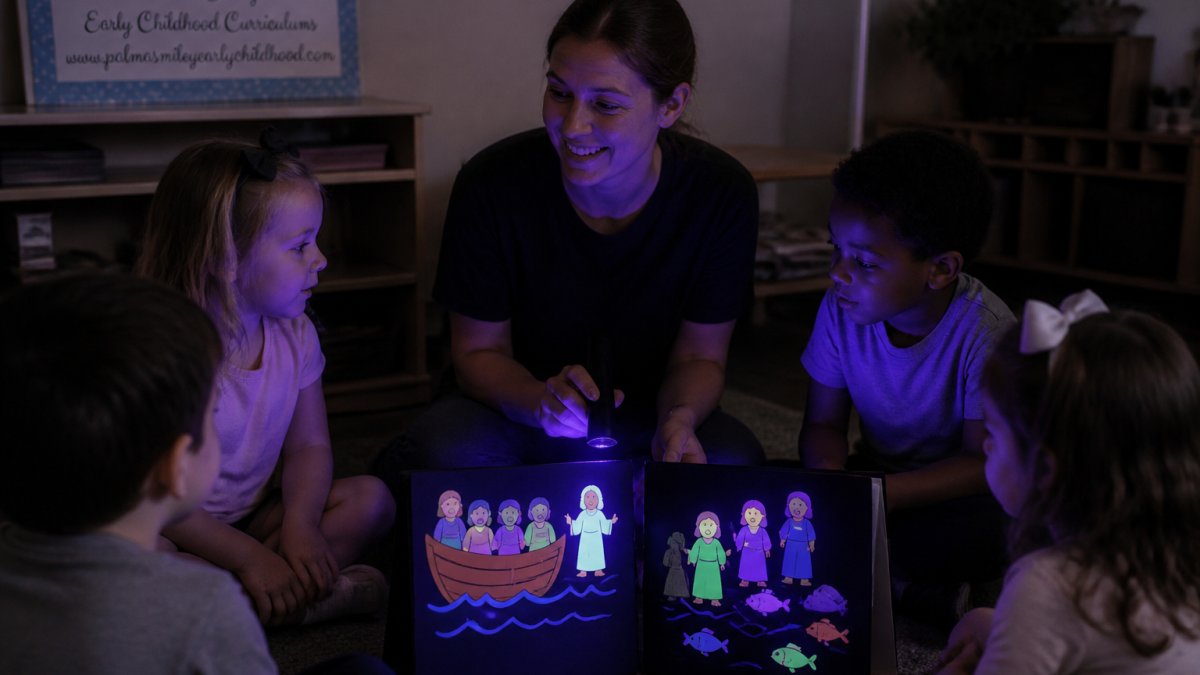
Sight: peek boards, puppets, black light story kits
Choosing a Preschool Sunday School Curriculum That Fits Your Room and Volunteers
The best preschool Sunday school curriculum is the one your volunteers can actually prepare and teach, not the thickest binder on the shelf.
Before you buy, answer three questions about your setting:
How many volunteers do you have, and are they trained teachers or willing helpers?
How much floor space and storage do you have for props and kits?
Do you teach one age group or a mixed nursery of babies through threes?
A small church plant with two volunteers needs something simple and self-contained; a larger children's ministry can carry more pieces. To browse options that match your room and team, our curriculum boxes show what a ready-to-teach kit looks like.
A Side-by-Side Way to Compare Resource Types
Rather than comparing brand names, compare the type of resource against your room, the comparison that decides whether a kit gets used or sits in a closet.
Resource type | Best age fit | Typical setting | Prep effort | Reusable? |
Ready-to-teach lesson kits (story, song, prop, phrase) | Babies through threes | Sunday school, nursery, Cradle Roll | Low, open and teach | Yes, week after week |
Story bags and prop sets | Toddlers and young preschoolers | Nursery, small group, home | Low to medium, gather and check pieces | Yes, with cleaning between uses |
Song and motion CDs or audio lessons | Babies through preschoolers | Any room with a leader | Very low, press play and lead | Yes |
Peek boards and black light story kits | Toddlers and preschoolers | Dim room, children's church | Medium, needs setup and a dark space | Yes |
Printable crafts and coloring pages | Older preschoolers | Home or classroom table | Medium, printing and supplies | No, one-time use |
Puppets and plush figures | Babies through preschoolers | Any room | Low, keep clean and stored | Yes |
Read the table by column, not by row. If your prep window is ten minutes before service, only the low-effort rows are realistic. For a mixed nursery of babies through threes, favor kits and props a sitting baby can mouth safely and a three-year-old can still enjoy.
Match the Resource to Your Volunteers, Not the Other Way Around
Small churches often run on a rotating team of willing helpers rather than trained teachers, which changes what "good" looks like. A resource is a fit when a brand-new volunteer can pick it up, hear the rhythm once, and lead it the same week. If a kit needs an hour of prep and a rehearsal, it will quietly stop being used by week three.
Ask two practical questions of any curriculum before you commit:
Can a first-time volunteer prepare this in under 30 minutes?
Does the lesson follow the same shape every week, so helpers learn the routine once?
Pro Tip Before you buy a full quarter, ask for or borrow one sample lesson. Teach it once with your actual team in your actual room. One real rehearsal tells you more than any product description.
Age Fit and Setting: The Two Filters That Matter Most
Age fit and setting narrow the field faster than anything else. A curriculum built for four- and five-year-olds assumes cutting, gluing, and sitting, none of which fit a Cradle Roll room of babies and toddlers.
Use these two filters in order:
Age fit: Does the lesson assume skills your children do not yet have (scissors, letter tracing, sitting still for ten minutes)? If so, it is a preschool resource, not a nursery one.
Setting: Does it need a dark room, a large floor, or a table? Match the physical requirements to the space you actually have.
When both filters pass, you have a short list worth comparing on prep effort and reusability, the point where a side-by-side look at curriculum boxes becomes useful rather than overwhelming.
Bible Lessons for Preschoolers: What a Complete Lesson Includes
A complete Bible lesson for preschoolers has four repeating parts: a story, a song, a prop, and a repeated phrase. Miss one and attention drops.
Story, Song, Prop, Repeat
This is the shape we build every lesson around, simple on purpose, so volunteers can run it without a theology degree.
Story: tell one Bible story in plain, short sentences
Song: sing a short song with motions tied to the story
Prop: hand out something to touch, like a toy animal or a glow star
Repeat: say the key phrase together, then do it again next week
To see this in action, a sample Creation lesson CD walks through a full lesson taught in an age-appropriate way, so a new volunteer can hear the rhythm before teaching it.
Hands-On Bible Activities for Preschoolers That Hold Attention
Hands-on Bible activities for preschoolers keep little hands busy while the story settles in. The goal is participation, not performance.

A few activities that work well with babies and toddlers:
Story bags: pull objects out one at a time as you tell the story
Peek boards: reveal a picture and let children name what they see
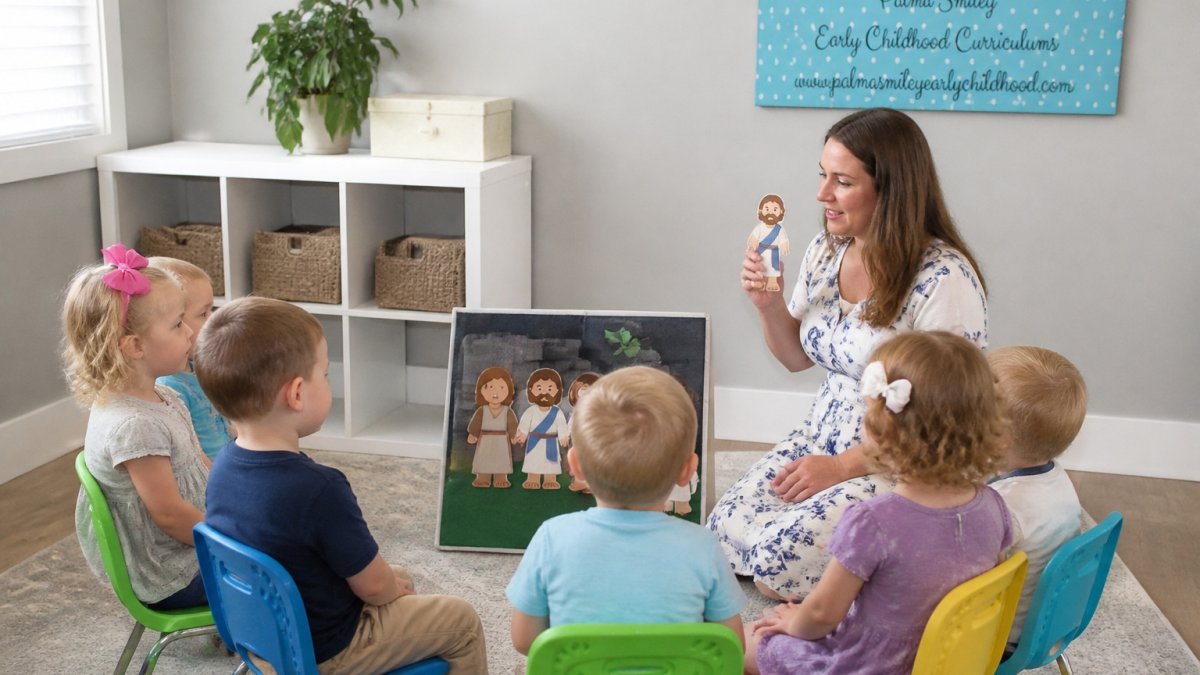
Puppet retelling: a puppet "helps" tell the story and greets each child
Our Stories in a Bag sets are built around exactly this idea: props that hold attention and make the story something a child can hold.
Match the Activity to the Child's Stage
A one-year-old and a three-year-old need different versions of the same activity; matching the activity to the stage keeps it from becoming a meltdown.
Babies (under 18 months): short songs with repeated motions, a soft prop to hold and mouth safely, and a puppet that comes close. Attention span is a minute or two; plan for repetition, not variety.
Young toddlers (18 months to 2.5 years): story bags with two or three large objects, peek boards, and songs with clapping. Fine motor skills are still developing, so avoid anything that requires precise grasping or fitting small pieces.
Older toddlers and young preschoolers (2.5 to 3 years): puppet retelling, naming what they see on a peek board, and simple sorting with animal toys. They can follow a two-step direction and enjoy being the helper.
Adapting Activities for Different Needs and Abilities
Not every child in your room will engage the same way. Some are shy, some are new to church, some have different learning needs, and some come from faith backgrounds where Bible stories are brand new. Build in options so every child can participate.
Offer a quiet alternative: a child overwhelmed by group singing can hold a soft prop and watch until ready.
Let participation be optional: a puppet can greet a child without requiring a response.
Use multiple senses: if a child does not track pictures, the song and the prop still reach them.
Key Takeaway The measure of a good activity is not how much a child produces. It is whether the child stayed engaged, felt safe, and heard the story one more time.
Supplies, Cleanliness, and Safety for Shared Props
Shared props in a nursery need to survive babies, mouths, and floors. Plan supplies and cleaning before the first lesson, not after.
Common supplies for these activities include:
Soft, washable props (fabric story-bag pieces, plush animals)
Cotton balls for clouds and a small basket to hold them
Glow stars for a dim-room moment
Cleanliness and safety matter as much as content in a room shared with babies:
Wipe hard props and surfaces between uses and between services.
Wash fabric props regularly, and keep a spare set for busy weeks.
Check small pieces before every lesson; anything that fits through a toilet-paper tube is a choking risk for under-threes.
Share the week's song and phrase with parents so the learning carries into the week, and let them know which props were used so families can talk about them at home. A simple note or text after service keeps parents connected to what their child touched and heard.
Toddler Church Nursery Activities for the Cradle Roll and Wiggle Years
Toddler church nursery activities need to survive wiggles, short attention spans, and a room full of babies. Simple, repeatable routines win here.
For the Cradle Roll and the under-threes, keep every activity short and physical. A song with clapping, a soft prop to pass around, and one repeated phrase is a full lesson. Wipe props between uses, check small pieces, and keep everything washable, then share the week's song and phrase with parents so the learning carries into the week.
How to Evaluate Developmental Fit, Safety, and Cleanliness Before You Buy
Evaluate any resource by asking whether a child can use it safely and whether it matches their stage. A beautiful kit a two-year-old cannot touch is not a fit.
Use this quick checklist before you order:
Are props large enough to be safe for babies and toddlers?
Can the pieces be wiped or washed between uses?
Does the lesson match the age you teach, or will you need two separate kits?
A Simple Weekly Plan That Blends Faith and Early Academics
Gather what you need ahead of time with our guide on what supplies you need for Sunday school, so the week runs without last-minute scrambling.
Planning Your First Quarter of Preschool Bible Lessons
Plan your first quarter around one story theme at a time, and repeat it for several weeks. Repetition is the point, not a fallback.
Pick one theme, such as Creation, and stretch it across the quarter
Match one song, one prop, and one phrase to each week
Rotate volunteers so no one burns out
Your first quarter of preschool Bible lessons does not need to be complicated. It needs to be repeatable, hands-on, and ready for volunteers who are not trained teachers. Palma Smiley Early Childhood builds Bible curriculum and teaching aids for babies, toddlers, and preschoolers, including black light story kits, puppets, peek boards, and story bags that make lessons engaging and simple to plan.
Frequently Asked Questions
What should a preschool Bible curriculum include?
A complete preschool Bible curriculum should include a short story told in simple words, a song with repeated motions, a sensory prop or object lesson, a hands-on activity, and a take-home note for parents. Look for materials that cover foundational Bible stories, build in repetition across weeks, and give volunteers a clear script so an untrained helper can teach confidently. Age-appropriate learning matters more than volume: two or three core truths repeated well beat a rushed survey of many stories.
How can I make Bible lessons for preschoolers more engaging?
Engage the senses, not just the ears. Use puppets, peek boards, story bags, and props children can touch, like cotton-ball clouds for a Creation lesson or glow stars for the night sky. Pair each story with a song that has repeated motions so children join in within a few weeks. Keep each segment short and vary the pace: story, song, prop, movement, then a simple craft. Repetition and routine help very young children feel safe and remember more.
Are there free Christian education resources for preschool Sunday school?
Some churches and ministries offer free printables, coloring pages, and story cards, and they can supplement a lesson well. Free resources often lack the props, scripts, and sequence that hold a toddler's attention week after week, so many leaders use them alongside a structured kit. If your budget is tight, start with a core curriculum for the main teaching time and use free printables for take-home pages and extra activities.
How do I keep toddler church nursery activities safe and clean?
Choose props that wipe clean or can be washed, and set aside soft fabric items for one child at a time. Check puppets and story bags for loose buttons or small parts before each session. Wash hands before and after snack and prop play, sanitize shared surfaces, and keep a small cleaning kit in the room. Brief volunteers on your church's safety and allergy policies, and share any concerns with parents the same day.
Subscribe to our newsletter
Add palmasmileyearlychildhood.com as a preferred source on Google →

Comments